Virtual OCPP Charge Point
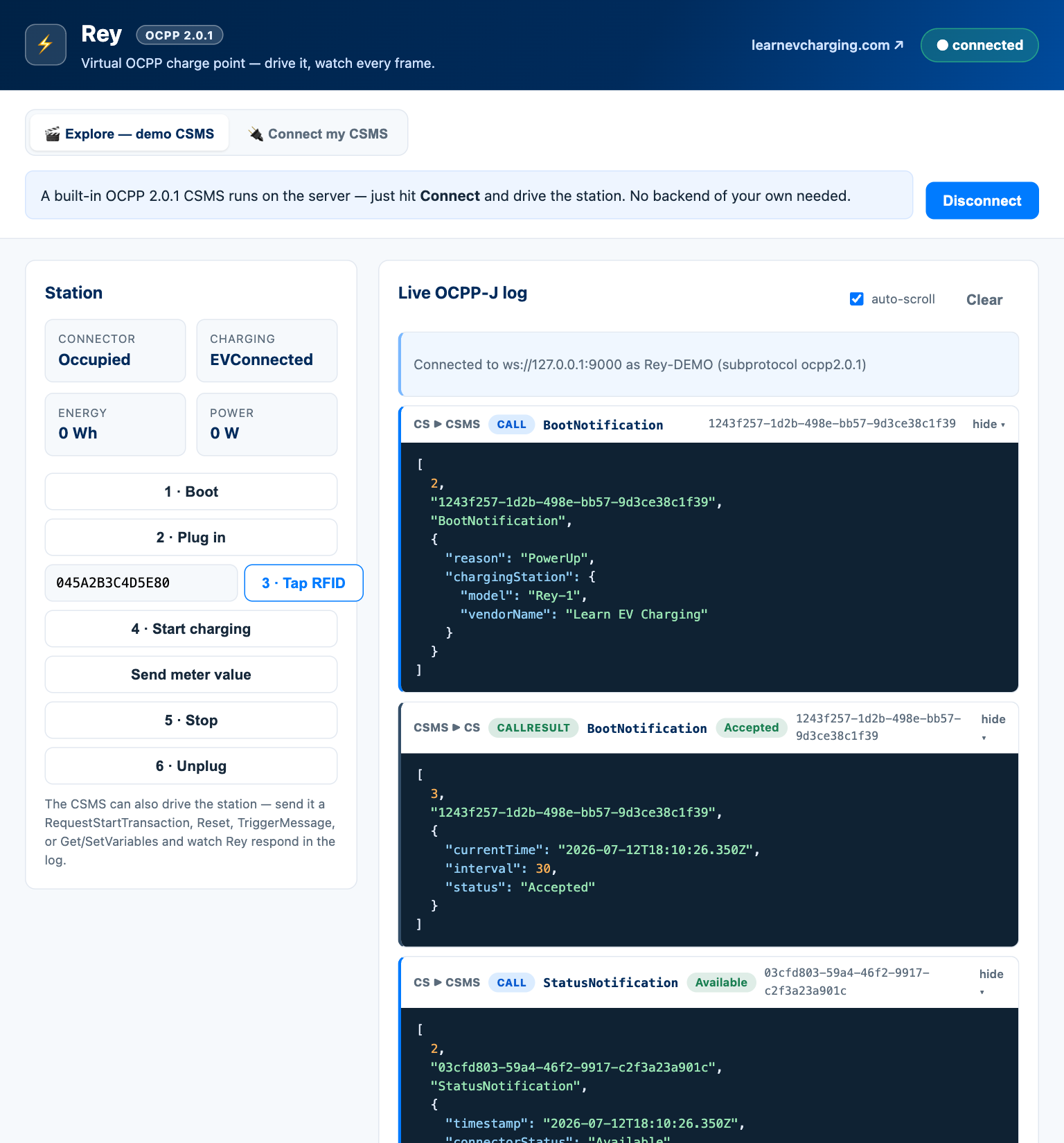
Rey is a virtual charging station you drive in your browser. Pick OCPP 1.6, 2.0.1 or 2.1 and point it at your own CSMS to test your backend with no hardware, or explore a full session against a built-in demo CSMS, zero setup.
Free · Runs in your browser · No install
Two ways to use it
🎬 Explore, demo CSMS
A built-in CSMS runs on the server for whichever version you pick (OCPP 1.6, 2.0.1 or 2.1), so you can drive a full session, boot, authorize, charge, stop, and inspect every frame with no backend of your own. The fastest way to see how OCPP behaves live.
🔌 Connect my CSMS
Enter your CSMS's wss:// URL (+ station id and Basic-auth password if needed) and Rey opens a real OCPP connection to your backend. Watch exactly how your CSMS handles a boot, an authorize, and a transaction, before any hardware is on site.
What you can test
- The boot handshake. does your CSMS return
Accepted, and set the heartbeat interval? - Authorization. how does it respond to an
idToken, and to a rejected one? - The transaction lifecycle.
StartTransaction→MeterValues→StopTransactionin 1.6, orTransactionEventStarted → Updated → Ended in 2.0.1/2.1. - CSMS-initiated commands. send a remote start, a
Reset, or aTriggerMessageand watch the station respond. - The device model. browse and edit the station's variables live, and see how
GetVariables/SetVariablesbehave (in 1.6, the flat configuration keys). - Certificate management (2.0.1/2.1), the station generates a real key and CSR, the CSMS signs it, and you see the installed certificate on the charger. The OCPP cert lifecycle, with real crypto.
- The wire format. every message shown as its real OCPP-J array, so you can copy frames as test fixtures.
New to the protocol? Start with what OCPP is, then watch the message flow in the OCPP simulator (a passive walkthrough), and come back here to test your own CSMS live.
Building a CSMS or charge-point firmware?
Rey helps you smoke-test it. The OCPP course takes you from reading frames to building the whole thing, the device model, the transaction engine, smart charging, and security profiles.
Frequently asked questions
What is a virtual charge point?
A virtual charge point (or charge-point emulator) is software that behaves like a physical EV charging station on the OCPP protocol, so you can test a CSMS or learn the message flow without any hardware. Rey is a browser-based one, you drive it in a tab and watch every OCPP-J frame.
Can I test my own CSMS with it?
Yes. Pick your OCPP version, switch to "Connect my CSMS", enter your CSMS's wss:// URL, a station id, and a Basic-auth password if it needs one, and Rey opens a real OCPP connection to your backend, boot, authorize, run a transaction, and see exactly how your CSMS responds. A relay presents the auth headers a browser can't set.
Do I need to install anything or wire up hardware?
No. Rey runs entirely in the browser. For a zero-setup look, the default "Explore" mode drives the station against a built-in demo CSMS, no backend of your own required.
Which OCPP versions does it support?
All three: OCPP 1.6 (1.6-J), the largest install base, plus OCPP 2.0.1 and OCPP 2.1, all over OCPP-J on WebSocket. Pick the version before you connect; Rey is the one charger across versions, so each speaks its own real message set (StartTransaction/MeterValues/StopTransaction in 1.6, TransactionEvent in 2.0.1/2.1).
Can it do certificates or Plug & Charge?
It demonstrates the OCPP 2.0.1/2.1 certificate lifecycle for real: click "Request a certificate" and the station generates a genuine RSA key pair and CSR, the built-in CSMS signs it (acting as a mini-CA) and returns it over CertificateSigned, and Rey shows the installed certificate, subject, issuer, serial, validity, and SHA-256 fingerprint. That is the cert machinery security profiles 2/3 and ISO 15118 Plug & Charge rely on. It is not the ISO 15118 EV-to-charger handshake itself, which happens on a wire a browser tool cannot reach.
Is it open source?
Rey is free to use and always will be. It is a teaching and testing tool rather than a product, so there is nothing to buy and no account to create.
How is this different from the OCPP simulator on this site?
The OCPP simulator replays a canned message flow so you can learn the sequence passively. Rey is a live charge point you drive against a real or demo CSMS over an actual WebSocket, use the simulator to learn the flow, use Rey to test your own backend.
Short OCPP and OCPI notes, the ones that never become full articles, go up on LinkedIn.