
The plug that fits your EV’s inlet decides which charging stations you can physically use. Wrong connector, and the cable does not go in. There are six connectors worth knowing, and the awkward part is that North America is midway through swapping one of them out, which is why adapters come up there and almost never in Europe.
This is the reference: six connectors, what each carries, and where each belongs.
The six connectors
J1772 (Type 1)
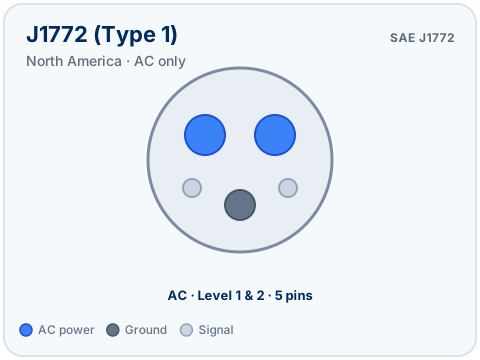
- Region: North America
- Power: AC only, covering Level 1 (1.4 kW) and Level 2 up to 19.2 kW
- Pins: Five (L1, L2, neutral, pilot, proximity)
- History: SAE-standardized in 2001, and the only open AC coupler defined for the North American market until J3400 arrived.
- Status: The coupler that North American Level 2 equipment is designed around. J3400 supplements it on newer vehicles rather than retiring the installed base.
Because J1772 was the only SAE AC coupler for that market before J3400 existed, a non-Tesla EV built for North America before 2024 has a J1772 AC inlet.
Type 2 (Mennekes)
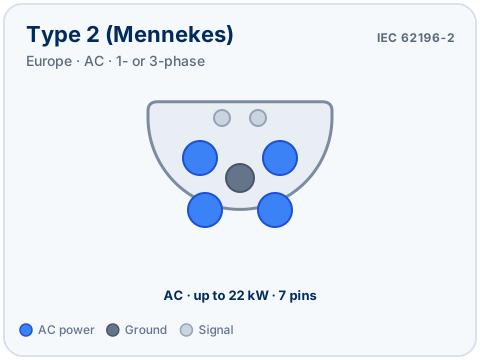
- Region: Europe, plus parts of Asia-Pacific
- Power: AC only. Single-phase up to 7.4 kW, three-phase up to 22 kW, and up to 43 kW where the station can supply 63 A per phase.
- Pins: Seven
- History: Named after the German manufacturer Mennekes and standardized as IEC 62196-2.
- Status: The specified AC coupler for Europe. Three-phase supply is ordinary in European buildings, so Type 2 was designed around it from the start, and that is why its AC ceiling sits so far above the J1772 ceiling.
Europe never split into two AC standards. The market a car is sold into determines the inlet, not the badge on the hood.
CCS Type 1 (Combined Charging System, Combo 1)
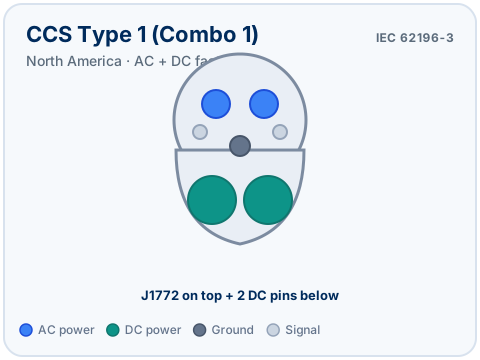
- Region: North America
- Power: AC and DC fast, with a DC ceiling above 350 kW on liquid-cooled cables
- Design: A J1772 face on top with two DC pins below. The car has one inlet that accepts either a J1772 plug (AC) or a CCS Type 1 plug (AC and DC). If the AC versus DC split (coming soon) is new to you, that difference is the reason one connector has to carry both.
- History: Standardized around 2014 as the open, multi-vendor alternative to a proprietary DC connector. It reused the J1772 control pilot line, so DIN 70121 and later ISO 15118 could run power line communication over wiring that already existed.
- Status: Until J3400 was published, CCS Type 1 and CHAdeMO were the only DC fast standards available to the North American market. What a CCS connector actually contains (coming soon) walks the housing pin by pin.
If your EV has a CCS Type 1 inlet, either a J1772 (AC) or a CCS Type 1 (AC and DC) cable will seat in it.
CCS Type 2 (Combined Charging System, Combo 2)
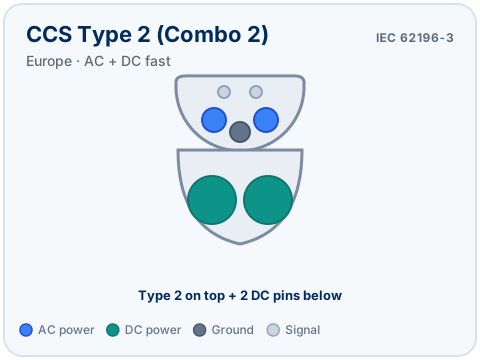
- Region: Europe
- Power: AC and DC fast, same DC ceiling as CCS Type 1
- Design: A Type 2 (Mennekes) face on top with two DC pins below.
- History: The European cousin of CCS Type 1. AFIR, the EU’s Alternative Fuels Infrastructure Regulation, requires CCS Type 2 on new public DC fast charge points.
- Status: With that requirement in force, a vehicle built for the European market is designed around CCS Type 2 for DC no matter who manufactures it.
CCS Type 1 and CCS Type 2 are not interchangeable. The DC pins look alike, but the AC half is a different geometry, and no passive adapter can reconcile the two.
CHAdeMO
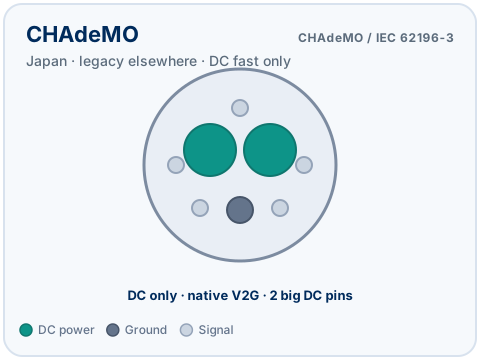
- Region: Japan primarily, legacy elsewhere
- Power: DC only. Early revisions of the standard top out at 62.5 kW (500 V at 125 A), and later revisions raised that ceiling substantially.
- History: Developed by a Japanese industry consortium and published in 2010, which made it the first DC fast charging standard in wide use.
- Status: CHAdeMO signals over a CAN bus on dedicated pins rather than power line communication on a pilot line, so it shares no communication layer with CCS or NACS. That gap, rather than the plug shape, is what made it awkward to carry forward outside Japan.
CHAdeMO (coming soon) carried bidirectional power flow natively, years before CCS gained bidirectional DC through ISO 15118-20. If that is the feature you are after, the V2L, V2H and V2G breakdown (coming soon) sets out what each mode actually demands of the car.
NACS (North American Charging Standard, SAE J3400)
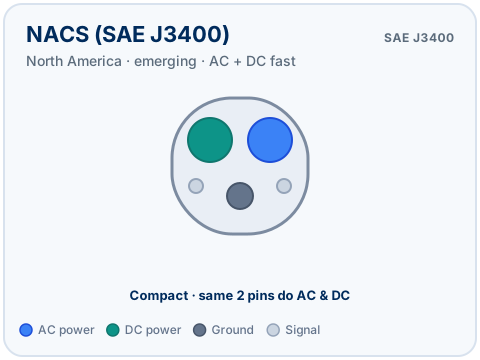
- Region: North America
- Power: AC and DC through the same pin pair
- Design: Two high-current pins carry AC or DC depending on what the station delivers, with the mode negotiated over the communication layer instead of being implied by which pins are energized. That is why the housing is smaller and lighter than CCS Type 1: it does not carry a second set of DC pins.
- History: Originally a proprietary Tesla connector, opened to the wider industry in 2022 and published by SAE as J3400 in 2023.
- Status: J3400 gives North America one coupler spanning AC and DC. CCS Type 1 could only reach the same coverage by stacking two connectors’ worth of pins into a single housing.
The NACS / J3400 switch (coming soon) covers the transition itself, including what it means for cars already on the road.
How connectors show up in charging network data
The connector on the car is one thing. The connector as a data field that networks exchange is another. When an operator publishes station data to apps and roaming partners over OCPI, each plug is a Connector object with a standard field drawn from a fixed enum: IEC_62196_T1 for J1772, IEC_62196_T2 for Type 2, IEC_62196_T1_COMBO for CCS Type 1, IEC_62196_T2_COMBO for CCS Type 2, CHADEMO for CHAdeMO.
NACS is the interesting case. The enum in OCPI 2.2.1 has no NACS entry; the nearest match is TESLA_S, which describes the same coupler mechanically. OCPI 2.3.0, published February 2025, extends the enum. That version gap is exactly how a roaming integration breaks quietly: a station goes out under a type string the receiving parser does not recognize, the parser drops or defaults the connector, and the site simply never appears in the app with the right filter. The OCPI version history tracks changes of this kind, and the OCPI Locations module covers how the full connector record is structured. OCPI is one of three protocols holding charging together; the OCPI vs OCPP vs ISO 15118 comparison shows where each one sits.
The mapping that matters
Geography is the fastest way to narrow down which connector you are dealing with:
flowchart TD
  R{Region?}
  R -->|North America| NA[J1772 AC<br/>CCS Type 1 DC<br/>NACS AC+DC]
  R -->|Europe| EU[Type 2 AC<br/>CCS Type 2 DC]
  R -->|Japan| JP[CHAdeMO DC<br/>legacy]
  style NA fill:#e8f4ff,stroke:#3b82f6
  style EU fill:#eafaf0,stroke:#22c55e
  style JP fill:#fff4e6,stroke:#f59e0b
Here is the practical version:
| If you have… | You can use… | You may need an adapter for… |
|---|---|---|
| J1772 vehicle (North America) | J1772 stations, and the AC half of a CCS Type 1 station | NACS stations |
| CCS Type 1 vehicle (North America) | J1772 stations (AC), CCS Type 1 stations (AC and DC) | NACS stations |
| NACS vehicle (North America) | NACS stations, AC and DC | J1772 stations and CCS Type 1 stations |
| Type 2 vehicle (Europe) | Type 2 stations, and the AC half of a CCS Type 2 station | Nothing. Europe is consolidated on Type 2 and CCS Type 2 |
| CCS Type 2 vehicle (Europe) | Type 2 stations (AC), CCS Type 2 stations (AC and DC) | Nothing |
| CHAdeMO vehicle | CHAdeMO stations | CCS stations, where the adapter has to translate protocols and not just pins |
The connector compatibility checker gives the result for every pairing of the six, and will my EV charge at that station works the same question from the driver’s seat.
The NACS transition explained
What happened: Tesla’s connector started out proprietary. It was opened to the rest of the industry in late 2022, and SAE published it as J3400 in 2023. That converted one company’s design into a coupler any manufacturer can build against, and any network can install without a licensing relationship.
Why a second North American coupler was worth the disruption:
- One connector spans AC and DC, so the car needs one inlet and the station needs one cable head.
- It is smaller and lighter than CCS Type 1, which matters at high current, where the cable is already thick and, on the fastest stations, liquid-cooled.
- Standardizing the coupler separated the connector from the network that popularized it. The Supercharger network’s architecture (coming soon) is a useful comparison for what that separation changes.
What it means if your car predates the switch:
- A J1772 or CCS Type 1 inlet is not stranded. CCS Type 1 and J3400 both signal over a J1772-style control pilot with power line communication, so an adapter between them is mostly a matter of rerouting pins. That is why those adapters stay compact and comparatively cheap.
- Station-side adapters attack the same mismatch from the other end. Both connector heads are built into the operator’s cable, so the driver carries nothing. Tesla’s “Magic Dock” is the name for that design.
What does not change:
- Europe is unaffected. AFIR points European public DC charging at CCS Type 2, and nothing in J3400 touches that.
- Cars already on the road keep the inlet they were built with. Changing an inlet means opening the high-voltage harness and revisiting the onboard charger, which is not a service-bay job.
- A J1772 home cable still works on a J3400 car through an adapter, because the AC side of the negotiation is identical on both.
Adapters, and where they stop
An adapter can bridge two connectors when the signalling underneath is the same and only the pin layout differs. It cannot bridge two connectors that speak different protocols unless it carries active electronics to translate between them, and that distinction is what separates a cheap adapter from an expensive one.
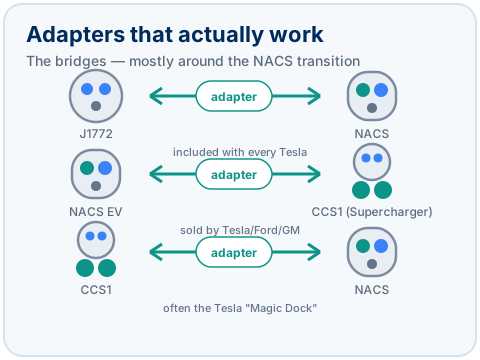
- J1772 to NACS: AC only. Same control pilot, different pin geometry, so the adapter can be passive.
- NACS to CCS Type 1 (DC): Both sides run power line communication over the control pilot, so this is again largely a pin remap.
- CCS Type 1 to NACS: The direction usually handled at the station rather than in the driver’s trunk, through the dual-head cable described above.
- CHAdeMO to CCS: CAN on one side, power line communication on the other. The adapter has to terminate one protocol and originate the other, which means active electronics, a power ceiling set by the adapter rather than by the car, and a price that reflects both.
What has no reliable consumer adapter:
- CCS Type 1 to CCS Type 2. Different AC geometry underneath, with no passive path between them.
- Type 2 to J1772. The same problem, one phase count apart: Type 2 carries three-phase AC that a J1772 inlet has no pins to receive.
- Anything crossing the Atlantic, broadly.
The full adapter compatibility guide (coming soon) goes pairing by pairing.
What the connector does not tell you
The plug is the most visible part of charging compatibility and the least decisive. Two cars with identical inlets at the same station can behave completely differently, because everything that determines whether a session starts happens after the pins mate: the control pilot handshake, the DC parameter exchange, and, where the station supports it, the certificate check that ISO 15118 (coming soon) defines for Plug and Charge. A connector that fits gets you to the negotiation. It does not get you through it.
The coupler is also the slowest-moving layer in the stack. Networks rebrand, apps get replaced, tariffs change every year or two, but the thing on the end of the cable outlives all of it, because changing it means changing vehicles that are already welded together. That asymmetry is why connector transitions feel glacial while they happen and abrupt in hindsight: the decision lands years before the hardware does, and the installed base takes a decade to finish arriving.
The Connector Compatibility Checker handles the lookups.